Development project on the Charvak Reservoir : concerns among lawyers, scientists, economists, and the public.
22.08.2025
Guljahon Amanova
Guljahon Amanova, Lawyer, Independent researcher in the field of human rights law, conducted a detailed analysis of violations of the domestic legislation of the Republic of Uzbekistan and its international obligations in the implementation of the large-scale development project “Sea Breeze Uzbekistan” on the southern shore of the Charvak Reservoir, approved by the Resolution of the Cabinet of Ministers No. 490 of August 2, 2025 . The decision was made despite widespread public outcry, direct warnings from experts, and the requirements of the Constitution of the Republic of Uzbekistan.
The Charvak Reservoir is a unique natural and ecological site of strategic importance for:
- drinking water supply for the city of Tashkent and surrounding regions,
- biodiversity (including rare and endemic species of plants and animals),
- local communities that depend on recreational, agricultural, and cultural access to these areas.
Brief chronology:
On December 16, 2024, Azerbaijani entrepreneur Emin Agalarov, co-founder of a similar resort on the Caspian Sea, presented a project to build the Sea Breeze Uzbekistan international tourist center in the Bostanlyk district of the Tashkent region to Uzbekistan President Shavkat Mirziyoyev . The president supported the proposal and instructed the creation of a commission headed by the prime minister, despite the fact that the news of the proposed construction on the shore of Charvak was immediately met with negative reactions from the population of Uzbekistan (read, for example, the comments under the first news item about such a project ).
At the end of December 2024, the president announced that the cost of the Sea Breeze Uzbekistan international tourist center on the shores of Charvak is estimated at $7-10 billion.
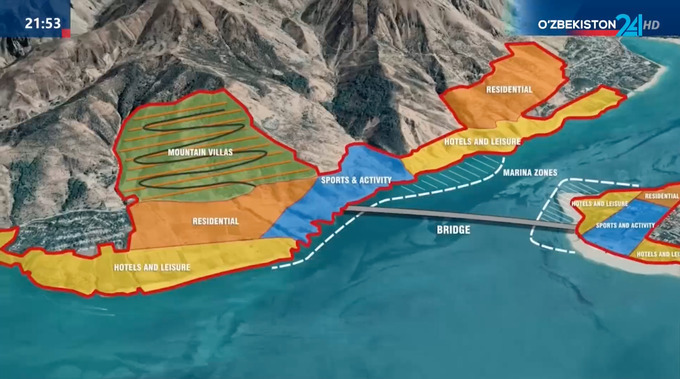
In April 2025, President Mirziyoyev reviewed a presentation of the Sea Breeze Uzbekistan master plan, developed with the participation of “several foreign companies.” However, the master plan itself was not made public, but it was indicated that the 500-700 hectare project envisages the phased construction divided into 10 compact zones. A boulevard, beaches, and recreation areas will be built near the water, while hotels, cottages, residential buildings, restaurants, and viewing platforms will be built on the slopes.
In June 2025, the Ministry of Investment, Industry, and Trade and the Azerbaijani company Agalarov Development signed an agreement on the implementation of the project to build the Sea Breeze Uzbekistan all-season resort in the Bostanlyk district of the Tashkent region, as reported by the ministry on its website without publishing the text of the agreement itself. Moreover, compared to the amount originally announced, the total cost of the project has been reduced by half to $5 billion.

Minister of Ecology Aziz Abduhakimov
In July 2025, Minister of Ecology Aziz Abduhakimov strongly supported the project, although he admitted that Sea Breeze Uzbekistan had not yet been approved and his ministry had not received any official documents regarding it. According to him, “if the project is submitted in accordance with the established procedure, it will be put up for public discussion, and construction in this area will not be possible until all expert reviews have been completed.” The minister called on the public to refrain from premature assessments, without understanding that the people has the right to express his opinion at any time, as well as to participate in the assessment and monitoring of projects affecting environmental issues – especially when it comes to a reservoir with fresh drinking water supplies for the population of Tashkent and the region, which, according to preliminary expert estimates, could pose a potential threat of environmental disaster and water shortages. To date, no documents on the project have been made available to the public.
Public reaction
All this news was accompanied by active discontent on the part of the Uzbek population, which could be observed under each news item in online media (Gazeta.uz, Spot.uz, Anhor.uz, Podrobno.uz, etc.), as well as on Facebook and LinkedIn. See, for example, the comments on the article in Gazeta.uz, or more than 100 comments on a Facebook post by hydrologist Khurshida Yakubova, which was shared by more than 1,000 users.
In his video, blogger Xudoyberdi Zomeniy reminds us that more than 150 archaeological sites have been found around the reservoir. Ninety percent of the drinking water that supplies Tashkent and the Tashkent region comes from this reservoir. In addition, the Charvak Reservoir is an important element in the power supply of Tashkent and the entire region thanks to its hydroelectric power plant (HPP). The Charvak HPP, which accumulates the mountain rivers Pskem, Kok-Su, and Chatkal, uses water from the reservoir to generate electricity, which is then supplied to the power grid of Tashkent and other cities.
Sustainable construction specialist Temur Akhmedov emphasized the importance of comprehensively studying any changes in the water balance: “Tashkent has a population of 3.5 million people, and New Tashkent is under construction. Where will we get water for everyone? If the balance at Charvak is disrupted, it will become a significant problem.”
Doctor of Natural Sciences Yulduzhon Abdullaeva spoke about the threat to biodiversity: “Rare plants grow and animals live in the reservoir area. Charvak water will be used for fountains and pools, which could disrupt its hydrological balance. It is imperative to conduct an environmental assessment of the project, and if the results are unsatisfactory, construction must be canceled,” the scientist believes.
A video by eco-blogger Urikguli (Mutabar Khushvaktova), in which she gathered the opinions of experts and influencers on the Sea Breeze Uzbekistan project, caused a huge response on social media—the video has been viewed more than 900,000 times on Instagram. Participants expressed their views on the possible impact of the future resort on the hydrological balance of the Charvak Reservoir. The video raises concerns about the likelihood of drinking water contamination and threats to biodiversity. There is also concern about the environmental impact assessment, about which no information is available yet.
The concerns of the population of Tashkent and the Tashkent region are also related to the fact that in matters of land expropriation, the rights of residents are usually violated and the courts are unable to restore the violated rights.
Petition

Mutabar Khushvaktova (Urikguli)
On July 17, 2025, eco-blogger Urikguli, together with a lawyer and other eco-activists, drafted and posted on the official public initiatives portal Mening Fikrim a draft petition addressed to the Uzbek Parliament, the Cabinet of Ministers , the State Committee for Ecology and Environmental Protection, and the Ministry of Investment, Industry, and Trade. She announced the publication of the petition on her Telegram channel.
The activists demanded:
- Conduct an independent and comprehensive environmental and social impact assessment (SEIA) of the Sea Breeze Uzbekistan project and other related facilities in accordance with Article 30 of the Law of the Republic of Uzbekistan “On Environmental Expertise,” Principles 2 and 3 of the Equator Principles, and other international standards. This assessment should include an analysis of the impact on biodiversity, water resources, soil, landscape, local communities, and the long-term sustainability of the region.
2) Ensure open and inclusive public hearings within the SEIA framework, involving independent environmentalists, relevant experts, local residents, civil society activists, and the scientific community. The results of the discussions should be publicly available and taken into account in the decision-making process.
3) Suspend the project until all assessment and consultation procedures have been completed in order to avoid irreversible consequences and maintain public trust.
4) Consider alternative approaches to regional development, including sustainable, environmentally friendly, and community-oriented tourism that does not disrupt the natural balance and preserves citizens’ right to free access to common resources.
5) Ensure compliance with the Aarhus Convention, ratified by Uzbekistan, including the right to access environmental information, participate in decision-making, and legal protection mechanisms in environmentally significant matters.
6) In the event of serious risks or insufficient justification for the project, review its parameters or completely relocate its implementation to another area where there is no threat to the vulnerable ecosystem and the rights of local residents.
However, the petition did not pass moderation and was rejected without explanation. The legal problem is that there is no mechanism for appealing the refusal to publish the petition, and the e-governmant portal does not provide the opportunity to challenge the actions of the authorities.
Decree of the Cabinet of Ministers of the Republic of Uzbekistan on the implementation of the project and the creation of a new company
On August 2, 2025, despite widespread public outcry, expert concerns, and earlier promises made by senior officials, and in violation of the requirements of the Aarhus Convention and the Constitution of Uzbekistan, the Cabinet of Ministers adopted Resolution No. 490 “On measures to implement a major investment project to create the year-round resort complex ”Sea Breeze Uzbekistan.”
The adopted Resolution does not provide for environmental guarantees, public consultations, or the possibility of appealing such a decision. The public has been effectively excluded from discussions on a project that could radically change the fate of Charvak, and with it the entire city of Tashkent and the Tashkent region, leaving the population with no drinking water reserves. Decisions are made behind closed doors, without open consultations with local residents, civil society institutions, and independent experts.
Despite all these violations and contrary to public calls to disclose the project documents and conduct a full-scale environmental assessment in accordance with international standards, on August 4, 2025, the ccompany Sea Breeze Uzbekistan LLC was registered in Uzbekistan as a joint venture in the Bostanlyk district of the Tashkent region. Its main activity is the construction of non-residential buildings. The company’s founders are Agalarov Development with a 50% stake and entrepreneur Ulugbek Abdurasulovich Makhmudov (50%) .
In accordance with Resolution No. 490:
20.1 SEA BREEZE RESORTS AND ENTERTAINMENT LLC (UAE) is granted a 25-year lease on a 577-hectare plot of land, with a priority right to extend the lease.
20.2The market value of the lease was estimated at 1.7 trillion soums (US$133.2 million), but the investor is only required to pay 17 billion soums (US$1.3 million) over 5 years — less than 1.3% of the market value. At the same time:
– the appraisal organization is not named,
– the methodology for applying the reduction coefficient is not disclosed.
20.3. The investor is granted the right to divide the plot into lots and sublease them to other persons within the framework of an approved but unpublished master plan.

Otabek Bakirov
Economist Otabek Bakirov published a detailed analysis, concluding that most of the risks and costs are being shifted to the Uzbek side. His questions about the lack of transparency in the selection of the investor, hidden infrastructure costs, and dangerous “exceptions” in construction standards showed that behind the facade of a “major investment” there could be a deal that is extremely disadvantageous for the country. Analyzing the text of the resolution, Bakirov drew attention to the discrepancy between the public promises of officials to create modern water treatment systems and the only formal environmental requirement in the document — connection to the sewerage system. On this basis, in his opinion, the investor “risks nothing” and can withdraw from the project at any time without significant losses.
Potential threats to the environment
Given Uzbekistan’s hot climate and existing concerns about drinking water shortages in the near future, any project that could potentially contaminate existing drinking water supplies (1) or pose a risk of physical damage to the dam, which could lead to flooding of the surrounding area and Tashkent (2), It must undergo a full-scale assessment, SEIA (Social and Environmental Impact Assessment), with the mandatory involvement of the population and ensuring public control over its implementation if independent assessments show that the project does not pose the above-mentioned dangers.
(1) According to experts, the shortage of fresh water in Uzbekistan could reach 7 billion cubic meters by 2030; by 2050, the shortage will double.
(2) The Charvak Reservoir is located in the Bostanlyk district, approximately 60-80 kilometers from Tashkent. It is situated at an altitude of about 1,620 meters above sea level. The dam that forms the reservoir is 168 meters high and holds about 2 billion cubic meters of water .

Khurshida Yakubova
In this regard, hydrologist Khurshida Yakubova warns in a detailed analysis that the key threat lies not so much in the quality of treatment facilities as in the enormous volume of irreplaceable water consumption from Tashkent’s main drinking water source. To illustrate this, she drew some striking analogies: the resort’s monthly consumption is equivalent to five days’ worth of water for the entire city of Tashkent, or “a belt of bottles wrapped around the Earth… twice.”
The expert explains: “The forecast for the Charvak Reservoir, taking into account current factors (decreased inflow, increased losses, and increased water withdrawals), shows that by 2030, the water deficit could reach -1.1 km³ in a pessimistic scenario, which will lead to a decrease in the reservoir level. At the same time, by 2032, with a continuing decrease in inflow (to 2.5 km³/year) and an increase in water abstraction to 0.7 km³/year, Charvak may reach dead volume (0.37 km³). This will threaten the water supply to Tashkent and the irrigation of agricultural land, as well as lead to serious environmental consequences.
In other words, regarding the resort’s water consumption: even with economical systems, SEA BREEZE will take 770,000 tons of water from Charvak annually — that’s like 300 Olympic swimming pools per year. The main “water guzzlers” are:
– Golf course — consumes as much as 3,000 homes daily (774 m³/day)
– Artificial sea — requires refilling as much as 80 swimming pools/year
In a dry year, the resort will consume every fourth ton of water.
The Charvak level may fall to a critical level. [Sources: Uzgidromet (2023), SEA BREEZE project documentation, water consumption standards (SNiP RUz 8.01-05).]
Sergey Starikov, a geophysicist, warns about Alpine folding in the area of the proposed full-scale construction, namely that “the construction of any object, such as a building with a large mass, can float. This means use of pile driving, which causes vibration,. … The Great Brichmula Fault, which encompasses smaller ones, and how all this will behave is known only to God.“
Khurshida Yakubova agrees, saying that Alpine folding poses a structural risk to any project in the Charvak zone, as well as ”complex geodynamics, fractured rocks, and potential shear zones — all of which require not just expertise on paper, but live calculations with a margin for unpredictability. And, as you rightly pointed out, ‘if something goes wrong, it will be too late’.
Violation of the domestic law and international conventions
Guljakhon Amanova, in her brief legal analysis, identified the key problems of the Resolution 490. Her post on Facebook was shared only 91 times from the main page.
The Resolution approves the implementation of a large investment project — a tourist and recreational complex worth $5 billion on an area of more than 2,000 hectares (clauses 1 and 4) in violation of Uzbekistan’s international legal obligations, including the Aarhus Convention, as well as Article 6 of the International Covenant on Civil and Political Rights, which includes “the obligation of states to protect the right to life from environmental degradation.” [General Comment No. 36 (2019) of the UN Human Rights Committee, paragraphs 26 and 62.]
In addition, the risks of forced evictions and the lack of guarantees of housing rights arising from the provisions of Resolution No. 490 were highlighted, since
1) it requires the termination of land use rights and the registration of plots as “free” for transfer to the investor (clause 6(a));
2) the last sentence of paragraph 6 obliges the investor to transfer $5 million to the Tashkent region budget as compensation. Firstly, this amount may not be sufficient for adequate compensation. Secondly, the Resolution and other clauses of the Uzbek legislation do not guarantee that the victims will receive it directly and in full, and the inaccessibility of the relevant documentation makes it impossible to appeal in court;
3) The resolution classifies the project as “socially significant,” creating grounds for possible compulsory land acquisition under the guise of public interest (clause 8(a)).
4) Non-compliance with international standards on housing rights: Article 11 of the International Covenant on Economic, Social and Cultural Rights (ICESCR) establishes the right of everyone to an adequate standard of living, including the right to housing. General Comment No. 7 (1997) of the UN Committee on Economic, Social and Cultural Rights on Article 11 of the ICESCR:
para. 13 — evictions are not permissible without adequate notice, consultation, and legal safeguards;
para. 15 — evictions should not result in homelessness or vulnerability.
-
- Basic principles and guidelines on development-related evictions (Annex to the Report of the UN Special Rapporteur on the right to housing, document A/HRC/4/18, 2007) require prior impact assessments, disclosure of information, individual compensation, and legal protection mechanisms.

Sayora Khodjaeva
As noted by lawyer and director of the association “Institute for Democracy and Human Rights” Sayora Khodjaeva, “Resolution No. 490 allows for the implementation of a large-scale investment project in circumvention of basic norms for the protection of human rights and the environment: without geological, environmental expertise and assessment of the impact on the environment, without guarantees of fair and direct compensation to those affected, without mechanisms for appeal and legal protection, and without determining the level of environmental hazard of planned and/or planned or ongoing economic and other activities that may have or are having a negative impact on the state of the environment and human health. ”
Sayora Khodjaeva emphasizes that “Article 115 of the Constitution, as a document of direct action, assigns one of the important tasks to the Cabinet of Ministers: ‘to ensure the implementation of a unified state policy in the field of environmental protection, preservation of natural resources and biological diversity, combating climate change, epidemics, pandemics, and mitigating their consequences’.
Moreover, Article 49 of the Constitution states that
“Everyone has the right to a favorable environment and reliable information about its condition.
The State shall create conditions for public control in the field of urban development in order to ensure the environmental rights of citizens and prevent harmful effects on the environment.
Draft urban development documents shall be subject to public discussion in accordance with the procedure established by law.
The state, in accordance with the principle of sustainable development, shall implement measures to improve, restore, and protect the environment and preserve ecological balance.”
Thus, the government’s decision was made in violation of the requirements of the Constitution.
Law No. ZRU-1036 “On Environmental Impact Assessment, EIA, and Strategic Environmental Assessment” was adopted on February 24, 2025, but the government stipulated that it would only come into force on August 25 . Despite the fact that the law did not enter into legal force, in conjunction with the Law on the Ratification of the Aarhus Convention, some of its provisions had to be taken into account by the government, since this large-scale commercial project “Sea Breeze Uzbekistan” is planned on the shore of the Charvak Reservoir, one of the most significant hydraulic engineering and natural sites in Uzbekistan, any pollution of which directly affects the quality and availability of drinking water in the capital (more than 3 million people).
On February 22, 2025, the Parliament (Oliy Majlis) of the Republic of Uzbekistan (RUz) approved, and on March 11, 2025, the President signed Law No. ZRU-1045 “On the accession of the Republic of Uzbekistan to the Convention on Access to Information, Public Participation in Decision-Making and Access to Justice in Environmental Matters (Aarhus, June 25, 1998).” In accordance with Article 15, Parts 3 and 4 of the Constitution of the Republic of Uzbekistan, “International treaties of the Republic of Uzbekistan, along with generally recognized principles and norms of international law, are an integral part of the legal system of the Republic of Uzbekistan” and, in case of conflict with national laws, have priority.
Provisions of the Aarhus Convention that are allegedly not being complied with
Based on the facts presented, we believe that the Republic of Uzbekistan is not complying with the following provisions of the Aarhus Convention:
Lack of access to information – Article 4 (paragraphs 1 and 2) Ensuring the right of every person to obtain environmental information held by public authorities.
None of the official platforms (Ministry of Ecology, Cabinet of Ministers, Tashkent Region Administration) have published:
- environmental impact assessment (EIA) materials,
- design and construction documentation,
- financial and economic justifications for the rental discount,
- data on the boundaries of sanitary protection zones and the impact on water resources.·
- The project master plan and implementation conditions are classified.
- An attempt by citizens to initiate a petition demanding disclosure of information and suspension of the project through the official portal petition.gov.uz was rejected without explanation.
Exclusion of the public from participation in decision-making – Article 6 (paragraphs 2, 3, 4, 5, 6, and 8): Public participation in decision-making processes concerning specific activities that have a significant impact on the environment.
- Despite the scale of the project, no public hearings were held at either the national or regional level.
- No official public notification of the project was published prior to its approval.
- A statement from activists, NGO representatives, and local residents (petition) emphasizes:
- “Decisions are made behind closed doors… The public is effectively excluded from discussions about a project that could radically change the fate of Charvak…”
- This is not just about the construction of facilities — it is about the structural transformation of the protected coastal landscape, with the risk of biodiversity loss, loss of public access to the water, and soil and landscape degradation.
- Despite this, public opinion was not sought at any stage of the project.
Lack of access to justice – Article 9 (paragraphs 1, 2, and 3): Ensuring effective access to justice in cases of denial of access to information, participation in decision-making, or other violations of environmental rights.
- Citizens were unable to challenge the actions of state authorities for the following reasons:
- No access to documentation (Agreement, EIA, master plan, financial justifications)
- Refusal to publish the petition precludes the use of official channels to express concerns
- Cabinet of Ministers resolutions cannot be challenged in court, and Resolution No. 490 itself does not refer to appeal procedures or public oversight.
- Despite Uzbekistan’s accession to the Aarhus Convention in March 2025, the national mechanism for implementing its provisions has not been put into practice.
Summary of the nature of the violation:
“We believe that the case in question is both specific and systemic in nature, indicating Uzbekistan’s failure to comply with the provisions of the Convention:
Non-compliance with the rules on access to information and participation in decision-making is not limited to a single project, but reflects the practice of state regulation of large development initiatives.
The disregard for the new Law on Environmental Impact Assessment, the lack of an appeal system, and the lack of a mechanism for informing citizens all indicate incomplete implementation of the Convention in national law and practice” , Guljahon Amanova concluded.
Translated by Farida Sharifullina
Source: Проект Sea Breeze на Чарвакском водохранилище: анализ нарушений законодательства — Housing news

'/%3E%3C/svg%3E)

